Here are some of my favorite practices when developing passage-based response writing skills with students. Keep in mind, it isn't my intention to teach-to-the-test, rather I feel the following skill will empower students to respond to a variety of writing assignments and situations - including all that test related stuff.
- A and B are student strategies.
- C and D are really for the teachers.
A is for ANNOTATING
Provide Students with an Effective Close Reading Strategy.
- Setup Word Walls - the purpose of word walls is to familiarize students with Tone and Theme terms and the synonyms associated with each. More details about this strategy can be located on my posts: Tone Posters and Theme Posters.
- # Paragraphs - On some assessments, the paragraphs or lines of text will be numbered. Ask students to number each paragraph. It will help organize the facts and details they will need to cite in their written response.
- C.U.S. - This simple acronym stands for Circle, Underline, and Star. As students read, they will mark-up the text using C.U.S. to highlight facts and details. For example, students would circle Tone words, underline Detail Words (not full sentences, just key words), and put a star next to important paragraphs that contain the topic summary and supporting points. Examples of Detail Words include names, places, and events.
B is for BREAKING
Provide the Tools to Deconstruct the reading for organizing and understanding.
The following strategies are meant to guide students into deep understanding and then the synthesis of multiple texts. It's good to model the process as a whole class, transition into small groups or paired work, and ultimately allow students to try each strategy independently. The following strategies can be used individually or in this sequence:
- Identify Claims and Evidence - Here are two terms you'll start seeing more often with the transition to Common Core: Claims and Evidence. Guide students to identifying the [1] Claim - a statement, the central idea/main idea, or argument - and the supporting [2] Evidence - facts, figures, details, quotes, or data. For more information, checkout CCSS Appendix A.
- GIST - Ask students to create a GIST sentence - a summary sentence written in exactly 20 words. The word restriction encourages students to focus on the central ideas and points of the reading. I would ask students to create a separate sentence for each reading.
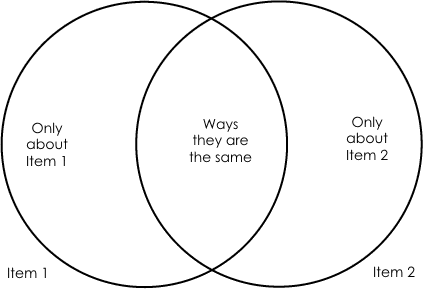
- Compare and Contrast - This is probably a familiar task for students. Setup a Venn Diagram and guide students through the similarities and differences between two texts.
C is for CREATING
Now it's time to write! Students will compose an original claim supported by evidence from the text(s). However, we still need a challenging prompt from which to respond!
When developing challenging prompts for students, I found it helpful to review the three modes of writing as described in Appendix A of the Common Core ELA Standards (page 23).
You can view my break down of the three modes here: The Big Three.
Once I've developed an understanding of the three writing modes, I can develop aligned prompts and tasks for my students.
First, I'll focus on a single mode. How about... the Informational/Explanatory mode? After reading Appendix A, I know it asks students to explain the why and the how. So, for my purposes, I'll ask students to read an appropriate grade-level text and describe how a theme is used by the author and support it with examples form the text.
How does the author use <insert a theme or appropriate figurative device> in the text to convey their message?How about an example of the Argument mode?
This is a little tricky in upper grades (6-12), because it requires more than one passage. Students will need at least two passages that represent opposing view points. The prompt should ask students to decide which view point holds more validity and use examples to support their claim.
The authors present their ideas on the topic of <insert the topic or hot button issue>. Describe each author's claim and cite their supporting examples. Develop your own claim on the issue and support it with facts and details presented in the text.Just for fun, let's look at an example for the Narrative Writing mode.
In an assessment setting, I imagine the Narrative mode will focus on inform, instruct, and persuade purposes. When being assessed, the passage would function as a model. For example, the 5th grade writing prompt uses a folktale and asks students to compose an original folktale to explain a phenomenon.
The author uses <a specific genre> to explain <topic or subject>. Use the conventions of <the same specific genre> to explain how/why <topic or subject>.
D is for DECONSTRUCTING!
Grading. It's easier said than done, but knowing how to respond to your audience will strengthen your writing. However, students won't always have rubrics after high school. When writing in college, I would almost always bomb my first major writing assignment. Not a big deal.
I took advantage of professor's office hours and spent 30 minutes listening to them explain what they were looking for and why I did not merit the A+ my mom said I deserved for everything I did. I was getting to know my audience in the absence of a rubric.
(Side Note: I had a great professor that admitted he became more critical when grading my writing after realizing I was pursuing a teaching career.)
In high school, we have rubrics so let's take advantage of them.
1. Give students a copy of the official writing rubric.
With your department or with your students, develop a student-friendly version - something they can easily digest and use to evaluate their writing (or that of their peers).
2. Save written student responses.
With students' permission, use the mid to high score papers as models. Just as you would have students analyze and critique professional writers, let them analyze the strengths and weaknesses of a set of their peers' writing.
(Side Note: I wouldn't use samples from the same class period. For example, I'll take my top 3-4 papers from my first period English class and, with the student writer's permission, share photocopies with my 4th period English class. Don't forget to white out the authors' names to eliminate possible biases.)
I took advantage of professor's office hours and spent 30 minutes listening to them explain what they were looking for and why I did not merit the A+ my mom said I deserved for everything I did. I was getting to know my audience in the absence of a rubric.
(Side Note: I had a great professor that admitted he became more critical when grading my writing after realizing I was pursuing a teaching career.)
In high school, we have rubrics so let's take advantage of them.
1. Give students a copy of the official writing rubric.
With your department or with your students, develop a student-friendly version - something they can easily digest and use to evaluate their writing (or that of their peers).
2. Save written student responses.
With students' permission, use the mid to high score papers as models. Just as you would have students analyze and critique professional writers, let them analyze the strengths and weaknesses of a set of their peers' writing.
(Side Note: I wouldn't use samples from the same class period. For example, I'll take my top 3-4 papers from my first period English class and, with the student writer's permission, share photocopies with my 4th period English class. Don't forget to white out the authors' names to eliminate possible biases.)
Mr. Flores-
ReplyDeleteYou're website has been a godsend. I'm a first-year teacher and the only writing teacher in my department for 5th grade. A website that includes more writing prompts is http://www.tncore.org/english_language_arts/writing_test/fifth_grade_prompts.aspx
Thanks for sharing! I appreciate the input. If you have anymore suggestions or resources, please feel free to share the wealth.
Delete